Exploring the intersection of human creativity, philosophy, and Artificial Intelligence.
Companies as a Service
For decades, the price of ambition was administration. To build a product, one first had to build an organization. We accepted this overhead as the cost of doing business. Although Agent Meshes could soon change how organizations work.
Packaging sets of specialized, interoperable AI agents sold as a cohesive ecosystem, we could just instantiate company functions on demand. Effectively moving us from a Software as a Service (SaaS) to 𝗖𝗼𝗺𝗽𝗮𝗻𝗶𝗲𝘀 𝗮𝘀 𝗮 𝗦𝗲𝗿𝘃𝗶𝗰𝗲 (𝗖𝗮𝗮𝗦) era. SaaS sold us instruments; CaaS would sell us outcomes.
When agents negotiate protocols and execute transfers autonomously, the "firm" ceases to be a physical place. It becomes a set of permissions running on a server. We have obsessed over the "10x Engineer", but we are now approaching the age of the "100x Founder".
Like the Moon
"𝘓𝘪𝘬𝘦 𝘵𝘩𝘦 𝘮𝘰𝘰𝘯, 𝘸𝘦 𝘮𝘶𝘴𝘵 𝘨𝘰 𝘵𝘩𝘳𝘰𝘶𝘨𝘩 𝘱𝘩𝘢𝘴𝘦𝘴 𝘰𝘧 𝘦𝘮𝘱𝘵𝘪𝘯𝘦𝘴𝘴 𝘵𝘰 𝘧𝘦𝘦𝘭 𝘧𝘶𝘭𝘭 𝘢𝘨𝘢𝘪𝘯"
In our current digital economy, emptiness is viewed as inefficiency. We are treating the human mind like a GPU, optimizing for 100% utilization. But human cognition is not linear compute. It is cyclical.
We often mistake "thinking" for progress. In reality, unchecked thinking is merely a loop of cognitive noise. If you are thinking too much, start writing. Writing is the compiler for the human mind. It forces us to abstract anxiety into concrete syntax.
Conversely, if you are feeling empty, start reading. Doom-scrolling is the nutritional equivalent of eating sawdust. True reading is the injection of new raw materials into our mental supply chain. We are engineering boredom out of existence, yet boredom is the quiet room where the mind connects disparate dots.
The End of Tool Mastery
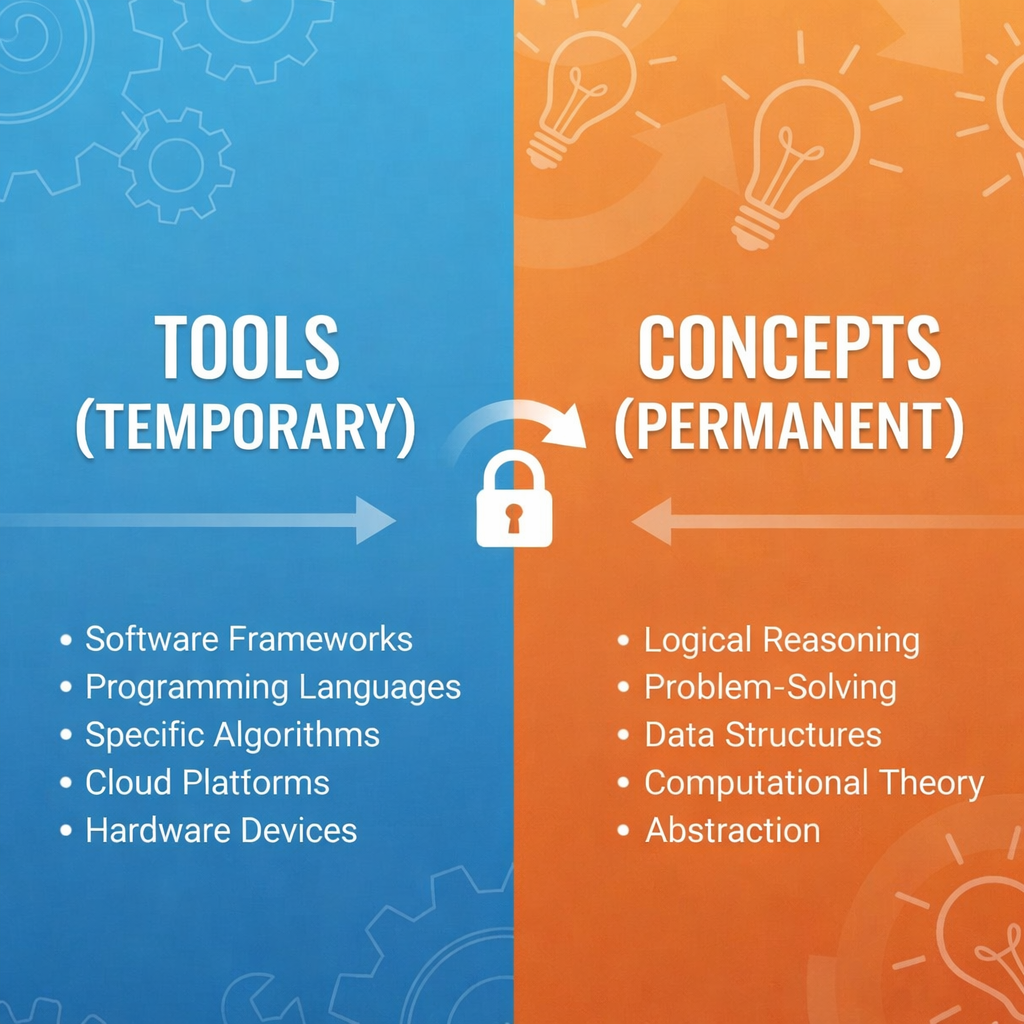
For the last twenty years, professional value was often calculated by one's ability to navigate a static interface. If you spent a decade memorizing the intricacies of Photoshop or the complex syntax of early coding frameworks, you possessed a moat. You held the keys to the castle because the castle walls rarely moved.
We are entering a period where the interface is fluid, but the underlying logic remains constant. To remain relevant, we must decouple our identity from the tools we employ and anchor it in the concepts they represent.
Tools will inevitably simplify until they become invisible. When the mechanism of creation is democratized, understanding first principles becomes the only differentiator.
The Renaissance Polymath
For the last century, we lived in the shadow of Frederick Taylor. Taylorism taught us to treat humans like components in a larger machine. We internalized this industrial logic, turning "self-improvement" into a quest for personal efficiency. But in 2026, this might as well be a trap.
The AI revolution is running the "Specialization Model" into the ground. We are witnessing a structural pivot from the era of the 𝗢𝗽𝘁𝗶𝗺𝗶𝘇𝗲𝗱 𝗦𝗽𝗲𝗰𝗶𝗮𝗹𝗶𝘀𝘁 back to the era of the 𝗥𝗲𝗻𝗮𝗶𝘀𝘀𝗮𝗻𝗰𝗲 𝗣𝗼𝗹𝘆𝗺𝗮𝘁𝗵. AI provides 𝗗𝗲𝗽𝘁𝗵 𝗼𝗻 𝗗𝗲𝗺𝗮𝗻𝗱.
The modern moat is no longer how deeply you know one domain, it is how effectively you connect three domains that have never met before. The value has shifted from the node to the network. We spent the Industrial Revolution trying to turn humans into parts of a machine. Now, the goal isn't to be a "well-oiled machine" anymore, it is to direct them.
The Artisan Model Returns
I feel like we are running the Industrial Revolution in reverse. Software development has spent 30 years perfecting the 𝗠𝗮𝗻𝘂𝗳𝗮𝗰𝘁𝘂𝗿𝗶𝗻𝗴 𝗠𝗼𝗱𝗲𝗹: One codebase. One standard UI. Distributed to 10M users. Optimized for scale and deterministic outcomes.
With Vibecoding and Generative UI, we are flipping back to the 𝗔𝗿𝘁𝗶𝘀𝗮𝗻 𝗠𝗼𝗱𝗲𝗹: One user. One bespoke interface. Generated on demand. Optimized for relevance and probabilistic outcomes. We moved from Artisan → Manufacturing to solve distribution. Now we are moving back to Artisan to solve fit.
We are trading consistency for utility. The question isn't if we can build it. It's how we support a product where every user is on a different version.
The Biggest Trap for Founders
The biggest trap for today's founders is asking: "What can I build with AI?" This question leads to a sea of sameness. AI-powered CRMs, AI-powered marketing copy, AI-powered code generators. It's a "1 to N" game: making existing things slightly better, faster, or cheaper. A race to the bottom where the only differentiator is your pricing model.
A better question could be: "What is a valuable problem that AI cannot solve?" This question forces you into "0 to 1" territory. It pushes you to find problems rooted in messy human interaction, nuanced domain expertise, or unique data moats — the very things large language models struggle with.
Don't use AI to outsource the core thinking behind your startup. That's your job. Use AI to augment your execution once you've done the hard, human work of finding a novel problem. The next breakthrough won't be an AI wrapper. It will be a human insight, supercharged by AI.

Progress as Abstraction
In software, progress has always been a story of abstraction. We moved from machine code to high-level languages, and then to APIs. We are now on the cusp of the next, and perhaps final, layer: abstracting away the UI itself.
It's a full-circle moment. The first computer interface was the terminal—a direct, conversational layer. We spent 40 years building GUIs to hide its complexity. Now, with Generative AI, we are returning to a terminal-like experience, but one where the "command line" is natural language and the response is a fully-formed, dynamic UI.
This inverts the traditional model. The interface is no longer the static contract the user must learn, the user's intent is the contract. We are moving from designing interfaces to designing interface generators.

The Cost of Starting
For the past decade, the cost of starting a software company has been a direct function of headcount. Venture capital was essential because it was primarily a fund for talent. AI is now fundamentally altering this equation.
The core operational tasks that once required a fully staffed seed-stage team are now being effectively managed by AI-augmented founders. This collapse in the cost of execution creates a seismic shift: the resurgence of capital-efficient bootstrapping.
The "one-person unicorn" is no longer a theoretical concept. Consequently, VC will pivot to "Deep Tech" moonshots. The era of raising millions for a simple app is coming to a close.
Wabi-Sabi in AI
Have you heard of Wabi-Sabi? It's the Japanese art of finding beauty in imperfection. With AI we can now generate flawless sentences, pixel-perfect designs, or code infrastructures. Perfection is becoming easy, accessible, and cheap.
But this doesn't make us obsolete. It liberates us. Our flaws aren't bugs to be fixed; they are the features of our humanity. We don't connect with polished facades; we connect with authenticity.
Perfection is static, imperfection is dynamic. While AI is designed to follow the rules and minimize deviation, true innovation comes from breaking them. Let's leave the commodity of perfection to the machines and get back to the business of pushing boundaries.
APIs and AI Agents
I recently started drawing some analogies between APIs and AI Agents. Think of an API as a single, well-defined function call. It's powerful, but it's largely stateless and task-specific. AI Agents, on the other hand, are akin to autonomous entities that can plan, reason, and adapt.
Where an API abstracts away the complexity of a single service, an AI Agent abstracts away the complexity of an entire workflow. This isn't to say APIs are obsolete; APIs become the tools in an AI Agent's toolkit.
We are moving towards a world where we interact with systems at a higher semantic level. Instead of writing code to stitch together multiple API calls, we will instruct an AI Agent with a goal, and it will intelligently manage the underlying executions.
Taste as a Differentiator
I've been thinking about a mantra once famously championed by Y Combinator: "Ideas are cheap, execution is everything." The ability to build, ship, and iterate was the ultimate moat. Although, the pace of innovation with generative AI is fundamentally challenging this dogma.
We're entering a new phase where AI is becoming a powerful execution engine. If execution is becoming a commodity, where does the value lie now? I believe it lies in "Taste".
When a machine can build almost anything you ask, the quality of your ask becomes the critical factor. Vision, deep user empathy, and a strong point of view are becoming the scarcest and most valuable resources. Execution isn't dead, it's evolving into the skill of collaborating with AI.

LEGOs and Creativity
Remember when a box of LEGOs was a universe of possibility? Now, many guide us to a single, pre-conceived outcome. This subtle shift from open-ended creation to methodical assembly is a metaphor for a much larger trend.
For decades, we've strived to make machines more human. The unintended consequence is that we may be making humans more machine-like—training our minds for linear logic over the beautiful chaos of genuine creativity.
But what if the very logic that powers AI could be used not to replace human thought, but to provoke it? Imagine AI not as an oracle with all the answers, but as a Socratic partner. The challenge is not one of technology, but of intention.

Directing AI: Hemingway vs. García Márquez
The way we direct AI video models like Google Veo is evolving from a technical instruction into a true creative art. Interestingly, the best way to understand this new art form is by looking at one of the oldest: the novel.
The way we craft prompts is strikingly similar to how history's greatest novelists chose their words. Your prompt is your prose, and your style dictates the entire visual narrative. Are you a minimalist like Hemingway, or do you follow the García Márquez approach?
There is no "better" style. The most effective creators will be those who can move between both. It's the difference between giving an instruction and telling a story.

The Era of Cognitive Offloading
What has always set humans apart is our ability to build tools. We started with fire and the wheel. Now, we've entered a new era. With Artificial Intelligence, we're no longer just automating physical labor, but intellectual work at a scale never seen before.
This new frontier of "cognitive offloading" presents a philosophical crossroads. The temptation is to outsource the rigorous process of thinking—the struggle, the synthesis, the breakthrough—for the immediate gratification of an answer.
The path forward with AI lies in our intention. By consciously choosing to engage with AI as an intellectual partner, we ensure that this new era doesn't lead to a more superficial humanity, but rather, a more profound one.

Self-Improvement Books vs. Fiction
Self-improvement books such as Atomic Habits are booming. But lately, I've found myself returning to fiction—not just for leisure, but for learning. Books like The Brothers Karamazov offer something deeper: pattern recognition, moral nuance, and emotional context.
Unlike rule-based learning, fiction teaches us through experience. We internalize values not because someone spelled them out, but because we felt them unfold.
Interestingly, this mirrors how today's most advanced AI systems learn. They don't just memorize rules. They learn through patterns, through exposure, through billions of examples. Storytelling has always been humanity's most powerful operating system. With AI, we're about to upgrade it.
Contacts
If you want to keep updated with my latest articles and projects follow me on Medium and subscribe to my mailing list. These are some of my contacts details:
